
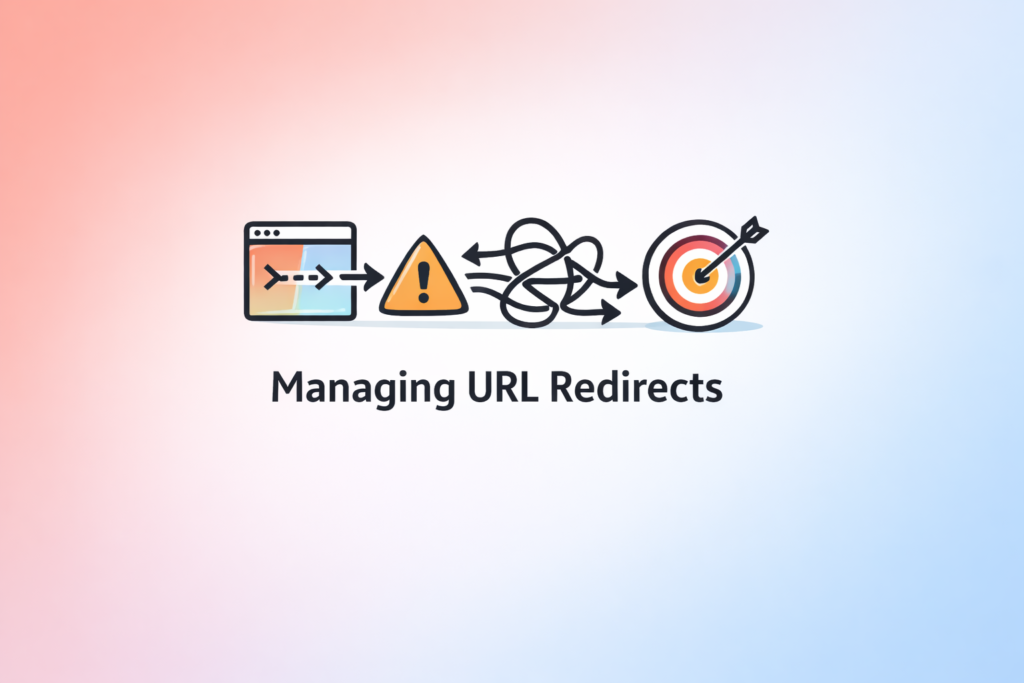
For small websites with a handful of pages, redirect management is simple. Create a redirect when a URL changes, confirm it works and move on. But as sites grow to hundreds or thousands of pages, and as organizations manage multiple domains, redirect management becomes a genuine operational challenge.
Most teams do not struggle with the concept of redirects. They struggle with maintaining them at scale. The problems that emerge are systemic: fragmented ownership, inconsistent tooling, undocumented rules and a growing backlog of technical debt that nobody owns.
The Scale Problem
A mid-size company with an active marketing team can easily accumulate hundreds of redirects in a single year. Product launches, campaign URLs, blog restructuring, acquisitions, rebrands, platform migrations and seasonal promotions all generate redirects. Multiply that over several years and several domains, and you are looking at thousands of rules spread across different systems.
At this scale, the individual redirect is rarely the problem. The problem is that nobody has a complete picture of what exists, where it lives or whether it still works.
Fragmented Redirect Management
One of the most common issues at scale is fragmentation. Redirects live in multiple places:
CMS plugins manage content-level redirects.
Server configuration files handle domain-level and protocol redirects.
CDN rules manage edge-level routing.
DNS forwarding handles bare domain redirects.
When different teams own different layers, conflicts are inevitable. A marketing team adds a redirect in the CMS. An engineering team adds a conflicting rule at the server level. Neither team knows about the other’s change. The result is a redirect chain, a loop or a rule that silently overrides another.
This fragmentation is particularly problematic because each layer processes redirects at a different stage. A DNS-level redirect happens before a server-level one. A server-level redirect happens before a CMS-level one. If all three layers have rules for the same URL, the result is often unexpected and difficult to debug.
The Documentation Gap
Redirects are rarely documented. When a developer adds a redirect to an Apache configuration file, the context, why it was created, who requested it, whether it is still needed, often exists only in that person’s memory or a long-closed support ticket.
Without documentation, maintenance becomes guesswork. Teams are reluctant to remove old redirects because they are not sure what will break. Over time, the redirect configuration becomes a fragile system that everyone is afraid to touch.
Documentation also helps with institutional knowledge. When someone leaves the team, that person’s understanding of the redirect system leaves with them. New team members face a steep learning curve figuring out why certain redirects exist.
Ownership and Accountability
In many organizations, nobody owns redirect management. Marketing creates redirects for campaigns. Engineering creates them during migrations. SEO teams request them for optimization projects. But no single person or team is responsible for the health of the overall redirect system.
This lack of ownership is what allows chains, loops and bloat to accumulate. Without someone regularly auditing and cleaning up redirects, entropy wins.
Building a Scalable Redirect Process
Solving this requires both tooling and process:
Centralize redirect management. Whether you use a dedicated redirect management service or maintain a single source of truth internally, all redirects should be visible and manageable from one place. Understanding how URL redirects work across different implementation methods helps teams make informed decisions about where redirects should live.
Assign ownership. Someone needs to be accountable for redirect health. This can be an SEO lead, a site reliability engineer or a shared responsibility with clear escalation paths.
Document every redirect. At minimum, record the source URL, destination URL, status code, date created, reason and owner. This turns an opaque system into something auditable.
Schedule regular audits. Quarterly reviews catch chains, loops, dead destinations and rules that are no longer needed before they compound into bigger problems.
Establish a request process. When someone needs a redirect, they should submit a request with the necessary details rather than adding rules directly to whatever system they have access to.
The Cost of Doing Nothing
Ignoring redirect management at scale has tangible costs. Site performance degrades as chains add latency to page loads. SEO value leaks as authority is diluted through unnecessary hops. Crawl budget is wasted on redirect chains that could be resolved with a single hop. And debugging becomes increasingly difficult as the web of rules grows more complex.
These costs compound over time. A single problematic redirect might have a negligible impact. But when you have thousands of redirects and dozens of chains and loops scattered throughout your system, the cumulative effect is substantial. You are paying the cost in lost rankings, slower pages and wasted engineering time.
The teams that get this right treat redirect management as infrastructure, not an afterthought. They invest in centralized tooling, maintain clean documentation and run regular audits. The payoff is a faster, healthier site that preserves the SEO authority it has earned and delivers a better experience for every visitor.
Some brands walk into the market looking clear, confident, and properly put together. Others look like they were assembled during a long lunch break, with a logo in one direction, messaging in another, and a website that seems to be having an identity crisis. The difference is not always budget. Very often, it comes down to whether the business has taken its brand strategy seriously from the start.
That is where brand consultants come in. They help businesses define how they should be positioned, how they should communicate, and how they should be perceived in a crowded market. In practical terms, they stop brands from saying ten different things at once and wondering why nobody remembers them.